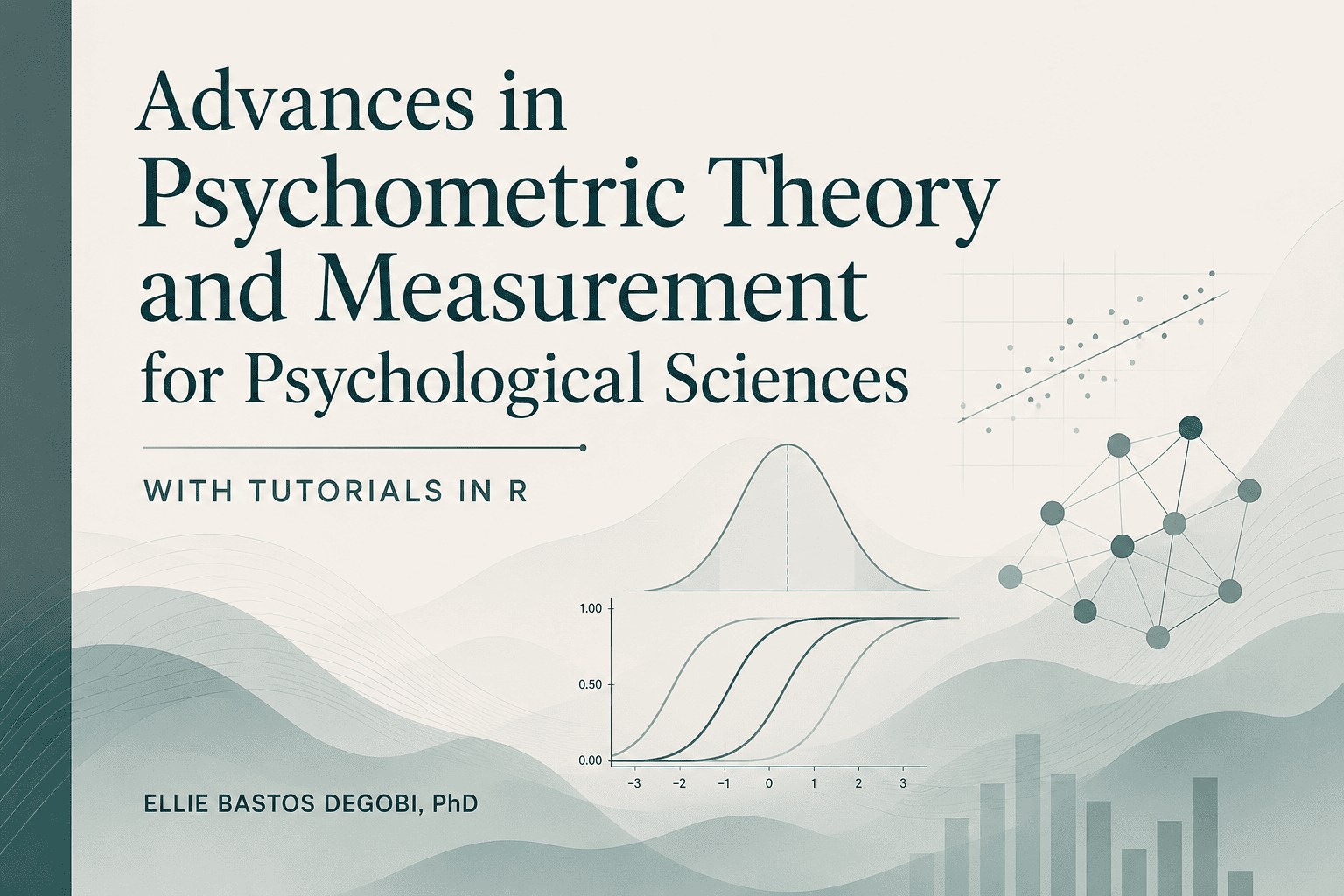
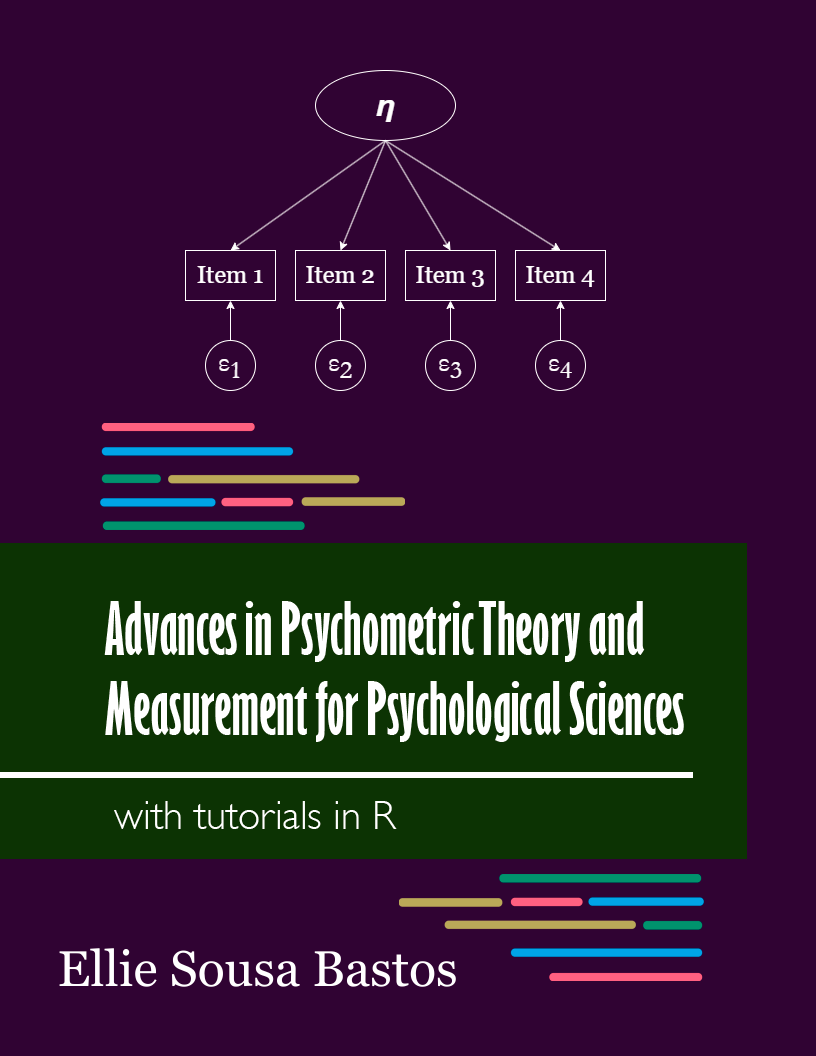
Advances in Psychometric Theory and Measurement for Psychological Sciences
With Tutorials in R

Overview
A practical route from the meaning of measurement to the models used to study psychological constructs.
Psychometrics is more than a collection of statistical procedures. It is the study of what scores mean, how they are produced, and when the conclusions drawn from them are defensible. This book connects those questions to the analyses researchers actually use.
The chapters move between conceptual explanation, statistical intuition, and reproducible examples in R. You can read the book from beginning to end or enter at the topic you need and follow the links between related ideas.
What this book is designed to do
The goal is depth without unnecessary friction. Each chapter develops the reasoning behind a psychometric problem before moving to implementation, so that the R code follows from the statistical and measurement assumptions rather than replacing them.
The book is intended for students, researchers, teachers, and practitioners who want to understand psychometric methods in enough detail to use them critically. It combines classical foundations with newer approaches and is maintained as an online open educational resource so that the material can evolve with the field.
Choose a route
Route 01 · Foundations Understand what measurement claims mean
Start with validity, Classical Test Theory, latent variables, and measurement theory. This route is the best entry point if you want the conceptual structure before the models.
Route 02 · Structure Study dimensionality and latent structure
Move through EFA, CFA, and Exploratory Graph Analysis to compare different ways of learning structure from multivariate psychological data.
Route 03 · Bias Examine how response processes distort scores
Use the social desirability and acquiescence chapters to understand systematic response patterns and strategies for modeling them.
Route 04 · Comparability Ask whether scores can be compared
Continue to measurement invariance and non-parametric IRT when your questions concern group comparisons, item behavior, and ordering along a latent trait.
Chapters at a glance
Chapter 1 Types of Validity in Psychological Tests
What validity evidence means and how different sources of evidence support score interpretation.
Chapter 2 Classical Test Theory
Observed scores, true scores, error, reliability, and the logic behind classical psychometric indices.
Chapter 3 Constructs and Latent Variables
How unobserved constructs relate to indicators and why latent-variable thinking matters for psychological measurement.
Chapter 4 Measurement Theory
The theoretical conditions under which attributes can be represented, ordered, and measured.
Chapter 5 Exploratory Factor Analysis
Dimensionality, extraction, rotation, factor retention, and an applied EFA workflow in R.
Chapter 6 Confirmatory Factor Analysis
Model specification, identification, estimation, fit, interpretation, and confirmatory modeling in R.
Chapter 7 Exploratory Graph Analysis
A network-psychometrics approach to dimensionality and community detection.
Chapter 8 Social Desirability Bias
Why socially desirable responding matters and how psychometric models can address it.
Chapter 9 Acquiescence Bias
The tendency to endorse items irrespective of content and approaches for identifying and modeling it.
Chapter 10 Measurement Invariance / Equivalence
The assumptions required for meaningful score and latent-mean comparisons across groups.
Chapter 11 Non-Parametric Item Response Theory
Mokken scaling and non-parametric approaches to item ordering and latent-trait measurement.
How to use the R tutorials
Read the conceptual section first, then reproduce the code with the same data before adapting it to your own analysis. When a function produces an index or decision criterion, focus on what the value represents and which assumptions make the interpretation reasonable. The purpose of the tutorials is not only to obtain output, but to connect each line of code to a psychometric decision.
A useful reading habit: when a chapter introduces a model, ask three questions before running it: What is being represented? Which assumptions make that representation possible? What would make the resulting score or parameter misleading?
Open, editable, and free to read
This online book is maintained as an open educational resource. If you find an error or have a suggestion, you can send me an email. The PDF and EPUB versions are available from the download menu, and the work is shared under a CC BY-NC-SA 4.0 license.
The content integrates ideas from my scientific work with research across psychometrics, measurement, and quantitative psychology. Keeping the book online makes it easier to revise examples, add developments, and correct material over time.
APA Citation
For the website version:
Degobi, E. B. (2026). Advances in Psychometric Theory and Measurement for Psychological Sciences: With Tutorials in R. https://elliedegb.quarto.pub/psychometrics/
For the pdf version:
Degobi, E. B. (2026). Advances in Psychometric Theory and Measurement for Psychological Sciences: With Tutorials in R. Zenodo. https://doi.org/10.5281/zenodo.21936760
BibTeX
About the Author

I dedicate this work to Phoebe, my lifelong love and partner.